Padel is a racket sport played in pairs on a small, fully enclosed court. The walls are part of the game, the serve is underhand, and the scoring follows tennis. If you can follow a tennis match, you can follow padel in a few minutes. This guide explains the essentials so you can enjoy any match you tune into, whether it is a pro tournament on a screen or friends playing at a local club.
What makes padel different from every other racket sport is simple: the walls. A ball that looks like a winner can come back. A point that seems over can continue. That single feature is why padel rallies run long, why defence is as exciting as attack, and why the sport has grown from a holiday experiment in Mexico to a global tour with events in 18 countries [citation:18].
This guide gives you everything you need to follow a match from the first serve to the final point. You will learn how a point works, how the scoring fits together, what the equipment does, where players stand and why, and what to watch for in your first match.
The basics in one minute
If you only remember five things about padel, make them these:
- Four players, two pairs. Professional padel is played as doubles. Two players on each side of the net.
- A small enclosed court. It measures 10 metres wide by 20 metres long, surrounded by glass walls and mesh fencing. That is about a third smaller than a doubles tennis court. See our guide to the padel court for the full layout.
- A solid racket and a tennis-style ball. The racket has no strings. It is a solid, perforated bat with holes, closer to an oversized table-tennis paddle than a tennis racket. The ball looks like a tennis ball but bounces slightly lower.
- An underhand serve. The ball is bounced on the floor and then hit from below waist height. No overhead serves. Read the full serve rules.
- Walls stay in play. After the ball bounces on the floor, it can hit the walls and still be returned. This is what makes padel rallies so long and so watchable.
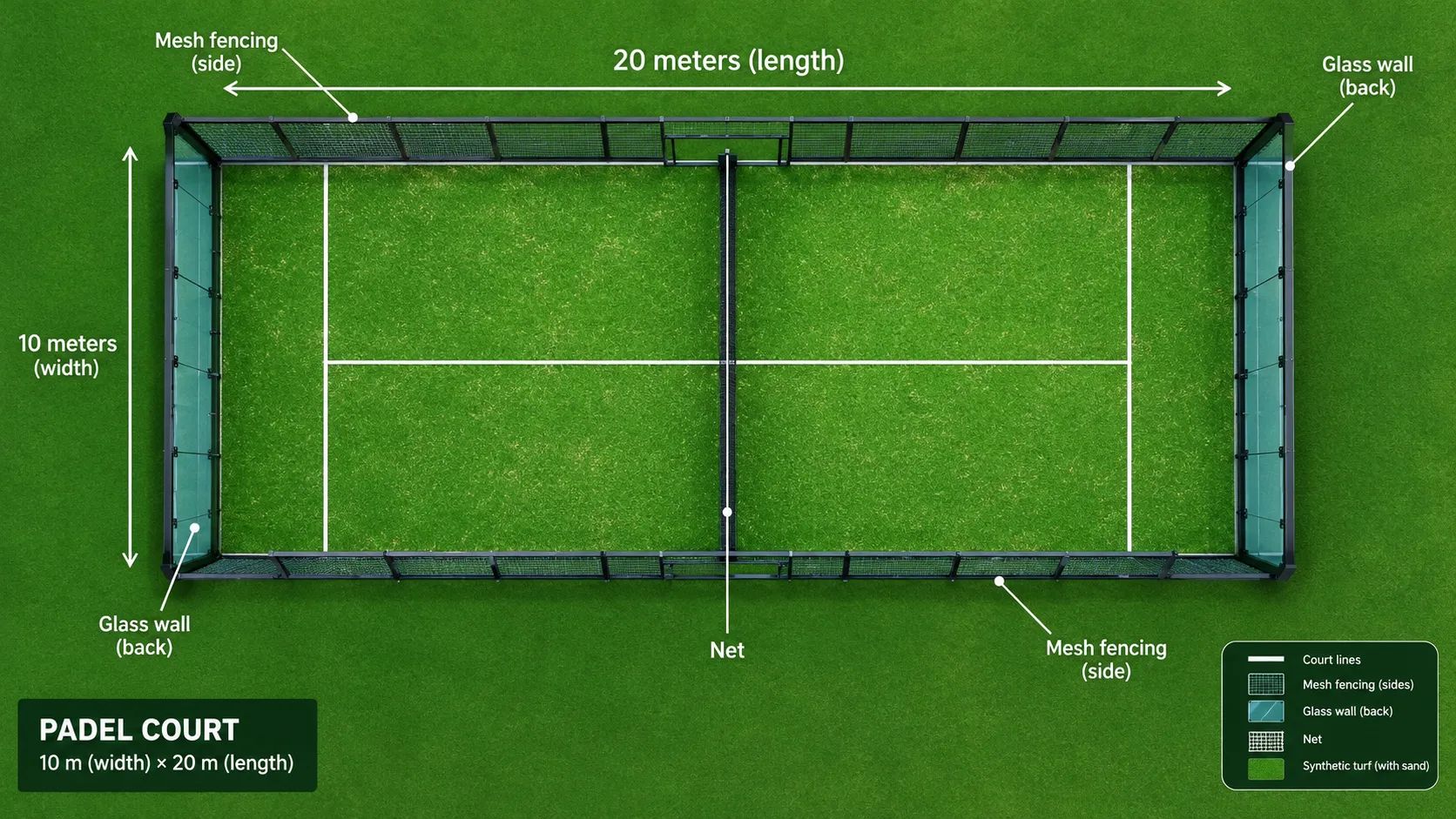
A point from start to finish
Every point follows the same rhythm, even if the rallies themselves vary wildly in length.
The serve. A point begins with a diagonal serve into the opposing service box, exactly as in tennis. The server stands behind the service line, bounces the ball, and hits it underhand. The ball must land in the box diagonally across the net from where the server is standing.
The return. The receiving player lets the serve bounce, then returns it. They cannot volley the serve out of the air. From this moment, the rally is live.
The rally. The ball can bounce once on each side of the net. After a ball bounces on your side, you may hit it immediately, or you may let it rebound off the walls behind or beside you and then hit it. This is the heart of padel. A ball that passes you is not necessarily lost. It might come off the back glass and sit up for an easy return. That is why you see players deliberately let balls go past them, then turn and play off the wall.
The rules of the wall. The ball must go over the net and bounce on the opponents’ side before it can touch any wall or fence on their side. If it hits the wall first, the shot is out. But once it has bounced, the walls become part of the game. Our guide to the wall rules explains every situation in detail.
How a point ends. A point finishes when the ball bounces twice on one side, goes out of play, hits a wall or fence in the wrong sequence, or a pair cannot return it. Players also lose the point if they hit the ball twice in a row, touch the net, or if the ball hits them or their clothing.
How scoring works
Padel uses the same counting as tennis: 15, 30, 40, and game. Six games win a set, and matches are usually the best of three sets. If you know tennis, you already know 90 percent of padel scoring.
The difference comes at 40-40, which is called deuce. Historically, padel has used three different ways to settle a deuce game:
- Advantage: a pair must win two points in a row from deuce to take the game. If they win one and lose the next, the score returns to deuce. This can continue indefinitely.
- Golden point: one single point decides the game at deuce. No advantages at all.
- Star Point: the system used on the professional tour from 2026. Up to two advantages are played. If the game is still level after two advantages, one final point decides it. The FIP General Assembly approved this change in November 2025, and it applies on Premier Padel and the CUPRA FIP Tour [citation:10][citation:15].
Our guide to padel scoring walks through a full game with a worked example, and we explain the Star Point in detail in What Is the Star Point in Padel?.

The equipment
Padel equipment is simple, but each piece matters for how the game feels.
- The racket. Solid, stringless, and perforated with holes. It has a flat or slightly shaped face and a short handle. Most are made primarily from carbon fibre. The rules cap its length at 45.5 centimetres and its width at 26 centimetres. Beginners often start with a round racket, which has a larger sweet spot and gives more control.
- The ball. A pressurised ball similar to a tennis ball, though it bounces a little lower. The rules require a diameter between 6.35 and 6.77 centimetres and a bounce height of 135 to 145 centimetres when dropped from 2.54 metres onto a hard surface.
- The court surface. Usually synthetic grass filled with sand. The sand slows the ball and gives players grip, which is one reason padel rallies are built on control and placement rather than raw power.
Where players stand (and why it matters)
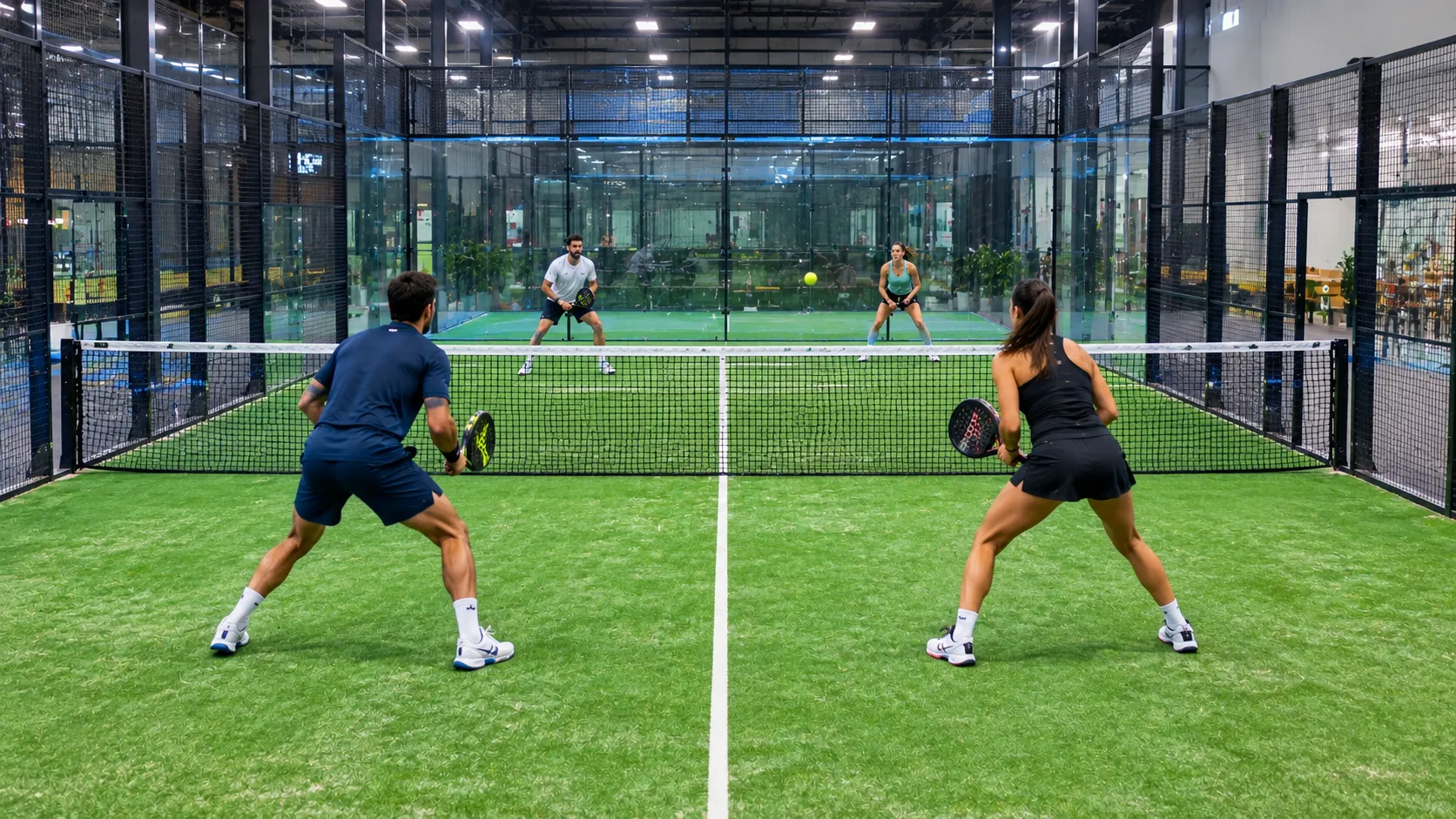
The single most important tactical idea in padel is this: the net is power. A player at the net can volley, attack, and finish points. A pair stuck at the back is defending, and defending in padel means surviving long enough to find a way forward.
So every point becomes a push and pull. The attacking pair tries to take the net and hold it. The defending pair tries to push them back with a high, deep ball called a lob. A good lob forces the net pair to retreat toward the glass, which gives the defenders time to move forward and take the net themselves.
When you watch a match, ignore the ball for a moment and look at the players. Which pair is closer to the net? That pair is almost certainly winning the point. The whole tactical battle of padel is about who controls that space.
The shots you will hear about
Commentators use a handful of Spanish terms constantly. Learning five of them will make any broadcast easier to follow. The full list is in our padel glossary.
- Lob: a high ball over the net players. The basic defensive tool and the main way to push opponents back.
- Bandeja: a controlled overhead played with slice. It keeps the ball low and deep without taking big risks. The name means “tray” in Spanish, describing the flat, carrying motion.
- Víbora: a sharper overhead with side spin. The ball curves and kicks off the glass awkwardly. The name means “viper.”
- Smash: a powerful overhead, usually hit flat and hard. Often a finishing shot.
- Chiquita: a soft, low shot aimed at the feet of a net player. Used to force a weak reply and allow the hitting pair to move forward.
What to watch for in your first match
You do not need to understand every shot to enjoy a padel match. Watch for these five things and you will follow the story of almost every point.
- Find the net pair. At any moment, one pair is usually attacking from the net. Everything else follows from that. Notice who is forward and who is back.
- Watch the lobs. A good lob flips the point. The net pair retreats, the defenders advance, and the whole geometry of the rally changes.
- Look at the glass. The best defenders do not chase balls. They let the ball come off the back wall and play it from there. Watch how they position themselves away from the glass, giving themselves room to swing.
- Follow the rallies. The small court and the walls keep the ball in play. Points can run twenty shots or more. Patience wins many of them, and impatience loses them.
- Wait for deuce. At 40-40, under the Star Point system, the tension changes. Up to two advantages, then one deciding point. It is the most dramatic moment in a game.
How padel differs from tennis (in one table)
If you come from tennis, these are the differences that will surprise you most:
- Serve: underhand, after a bounce, below waist height. Tennis is overhead.
- Court: 10 by 20 metres, fully enclosed. Tennis has no walls.
- Racket: solid and stringless. Tennis rackets are strung.
- Walls: in play after the bounce. Tennis has no equivalent.
- Players: doubles is the standard at every level. Tennis singles is the headline format.
We go deeper in Padel vs Tennis: The Key Differences.
A short history
Padel was invented in 1969 by Enrique Corcuera in Acapulco, Mexico. The story goes that he wanted a tennis court but did not have enough space, so he built a smaller version and enclosed it with walls to stop the balls from escaping [citation:3][citation:13]. His wife, Viviana, gave him an ultimatum: build a proper court in Acapulco, or she would return to Argentina. He built it.
The game spread to Spain in 1974 and to Argentina in 1975. By the 1980s and 1990s it had become a serious sport in both countries, and transparent glass walls replaced opaque ones, allowing spectators and cameras to see the whole court. The first world championship was held in 1992. Today, padel is played worldwide, and the professional tour has 26 tournaments in 18 countries in 2026 [citation:18]. You can read more in why padel is growing so fast.
Quick answers
Is padel only played in doubles?
Professional padel is played as doubles. Singles formats exist at amateur level but are rare. The enclosed court and the walls make doubles the natural format, because two players can cover the space together.
Is padel easier than tennis?
It is easier to start. The walls keep the ball in play, the serve is underhand, and the court is smaller, so beginners can rally within minutes. At the top level, padel is every bit as demanding as tennis.
Do you need to be a tennis fan to enjoy padel?
No. The scoring will feel familiar to tennis fans, but everything else in this guide is enough to follow a match. Many padel fans have never played tennis.
Why do players hit the ball off the walls?
Because the rules allow it, and because it works. After the ball bounces on your side, it can hit the walls and still be returned. Good defenders use the walls to buy time and to rescue points that would be lost in any other racket sport.
What is the Star Point?
A scoring rule used on the professional tour from 2026. At deuce, up to two advantages are played. If the game is still level, one final point decides it. We explain it fully in What Is the Star Point in Padel?.
Where to go next
- Padel scoring explained to follow the scoreboard without hesitation.
- A padel glossary for every word commentators use.
- The padel court explained for the dimensions, lines, and walls.
- How to watch padel to find a match this week.
- How the Premier Padel tour works to understand the pro game.
For the official rules, read the FIP Rules of Padel.